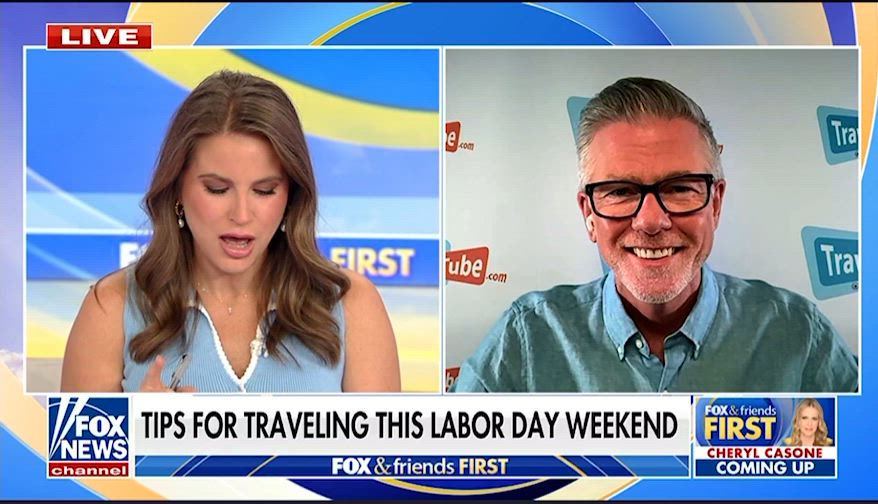
TravelTube.com — Weekly Episode Transcript
Hey folks, Mark Murphy here with TravelTube.com, the Travel Expert Channel. Why do we call ourselves the Travel Expert Channel? Honestly, I'm not as much of an expert as a well-informed travel advisor — and that's exactly why I position travel advisors as the actual travel experts. I do this on my own time, at my own expense, and all I ask in return is that you follow us on your podcast apps, follow us on social media, and sign up for our free newsletter. That's it. No money, just those three things.
This Week's Topics
Here's what we're covering today: travel advisories and what overseas governments are saying about visiting the U.S.; Amsterdam's new ban on ads for meat and fossil fuels; Hantavirus and cruising — should you be worried?; the United Airlines incident at Newark; Delta's new policy cutting food and beverage on short flights; and how travel advisors can boost their bottom line while better serving clients.
Travel Advisories: Is the U.S. Safe to Visit?
Most international travel advisories targeting the United States focus on gun violence. However, studies show that if you remove the five worst urban areas for gun violence — where the majority of incidents are concentrated — the U.S. moves from near the bottom to near the top of global safety rankings.
The pattern is similar to how advisories work for Mexico. A country-wide warning may flag cartel violence, but when you drill into specific tourist areas like Cancun or Cabo, they're generally very safe. Anyone in the travel industry knows the broad advisory doesn't reflect what tourists actually experience in those destinations.
The same common sense applies to the U.S. Avoid unfamiliar urban neighborhoods, stick to populated tourist areas, and you'll be fine — just as you would in Paris, London, or Stockholm, all of which have their own no-go zones.
Regarding open carry and legal gun ownership: legal gun owners are almost never the source of violence. The real risk comes from criminals who disregard laws entirely — a reality my own family experienced firsthand when my brother was killed in 1988 by a convicted felon carrying an illegal firearm.
Bottom line: apply common sense to travel advisories and don't let alarmist headlines keep you from visiting great destinations.
Amsterdam Bans Ads for Meat and Fossil Fuels
Amsterdam has banned billboard advertising for meat products, SUVs, and fossil fuels under the belief that removing ads will change consumption behavior. It's worth noting that during global COVID lockdowns, carbon emissions dropped approximately 17% worldwide — yet temperatures still rose during that period, suggesting the relationship between emissions and temperature is more complex than often presented. If a near-total halt to global activity only reduced emissions by 17%, the math on reaching net zero by 2050 through advertising bans deserves scrutiny.
Hantavirus and Cruising
There's been significant news coverage following a cruise ship departing Argentina where passengers contracted Hantavirus. The WHO has noted person-to-person transmission is possible, with a reported 40% fatality rate in some cases. A vaccine is reportedly in development.
That said, if you have a cruise booked, don't panic. Apply the same critical thinking we saw during COVID: consider who is actually at risk, look at the actual transmission vectors, and don't let media coverage drive your decisions. During the early days of COVID, my wife sailed on a short NCL cruise out of South Florida despite daily headlines — because we assessed the actual risk level for a healthy individual and made a sensible call.
Cut through the noise, get to the facts, and travel accordingly.
United Airlines Incident at Newark
By now you've likely seen footage of the United Airlines flight that clipped a truck and a pole with its landing gear on approach to Newark. Remarkably, the plane landed safely and everyone on board walked away.
A retired United flight attendant I know raised an important point: the runway in question — believed to be Runway 29 — may not be rated for a 767. According to pilots she's spoken with, the largest aircraft that runway should accommodate is a 757 or regional jet. Any pilot who received ATC instructions to land a 767 there would, according to her colleagues, have refused and requested a different runway.
We won't know the full story until the FAA completes its investigation, but the approach over the New Jersey Turnpike at low altitude, combined with a shorter runway not designed for wide-body aircraft, appears to be a significant factor. The remarkable thing is that despite all of this, everyone survived — a testament to the aircraft and crew.
Delta Cutting Food and Beverage on Short Flights
Starting around May 19th, Delta will eliminate food and beverage service on flights under 350 miles. Is this purely a cost-cutting move? Partly — but it also makes operational sense.
A 349-mile flight spends roughly 30 to 40 minutes in the air, including takeoff and landing. That leaves flight attendants a 15-to-20-minute service window, often on full regional jets where passengers in the back may not get served at all. On flights that short, in-flight service adds limited value while creating real logistical strain.
Flight attendants' primary role is passenger safety, not food service. Keeping them seated during brief flights is arguably the right call. Expect other carriers to follow suit on similarly short routes. And if it contributes to a slightly better bottom line for Delta — and potentially lower fares — that's a reasonable tradeoff.
Boosting Your Bottom Line as a Travel Advisor
Here are two practical ways to add value for your clients while increasing your revenue.
Custom Group Merchandise: When you're booking a family reunion, milestone trip, or group travel, consider offering custom shirts or branded items. A well-designed shirt with your logo, the trip date, and destination becomes a walking advertisement for your business — and a lasting memory for your clients. You don't need to manage all the logistics yourself. TravelingBagsMKE.com (travelingbagsmke.com) can create custom T-shirts, tote bags, and other specialty items. They'll set up a dedicated purchase link so your clients can choose their own sizes and pay directly — or you can purchase the items as a gift if the commission warrants it. For a group booking generating solid commission, spending $20–25 per person on custom shirts is an easy investment.
Travel Accessories Affiliate Revenue: For clients heading somewhere like Alaska on a cruise, proactively recommend practical gear — binoculars, luggage tags, passport holders, portable charging blocks. Send them a link to TravelingBagsMKE.com, where they can shop at great prices. If they purchase through your affiliate link, you typically earn around 15% — essentially free commission on top of your booking fee. Sign up for their affiliate program, share the link, and let them handle fulfillment. You do nothing except serve your client better.
These are small touches that reinforce your value, strengthen client relationships, and grow your revenue without adding significant work.
Coming Up Next Week
We have two great interviews lined up: one focused on building group travel business, and another with David Chate, founder of Travelify.com. David has added significant new features to the platform since we last spoke, creating end-to-end solutions that even existing users may not be taking full advantage of.
In the meantime, follow TravelTube.com on Apple Podcasts, Spotify, Amazon Podcasts, TikTok, Instagram, and Facebook — and sign up for the free newsletter at TravelTube.com. Thanks for tuning in, and I'll see you next week.